Category: Video Game Reviews

  • A Game for Squares: Thomas Was Alone Review

    TWA Logo

    I’m not going to talk about this game excessively, because it is a game of no excess itself.  Originally released as a Flash game in 2010, it was created solely by Mike Bithell; the only collaborative part of the game is the phenomenal soundtrack, which Bithell co-created with David Housden. Since then, it has seen releases on PC, Mac, Linux, PS3 and PS Vita. It is a puzzle-platformer where the player takes control of several AIs, who represent themselves as various quadrilaterals in a 2D environment. Each AI has a unique shape or ability that the player must use in conjunction with the others to progress through each level. The story is told through text, with accompanying narration by Danny Wallace.

    TWA Intro

    And that’s about as far as I want to go into things, other than to tell you that you should go pick it up and play it, right now; or at least the next time you have three-and-a-half hours of free time. Journey, The Unfinished Swan, Quantum Conundrum, and Antichamber are the closest things I can think to compare it to, because these are all games that hinge on how much you are willing to give to them and receive in return. I’m sure there are people who would never be able to see these characters as more than colored rectangles; I personally came to feel very close to Thomas, Chris, Laura, Claire, John, James, and Sarah.

    TWA Founders

    I mentioned the music and narration because the game simply would not be what it is without the involvement of either party. The score is a “procedurally-generated assembly of multiple instrument tracks over a fixed song line” according to Wikipedia. That’s the technical term for something I had noticed during play, which is that each track starts out small and then slowly builds over the course of not just each level, but each world as well. I often found myself pausing to just listen to it in the background; I also found myself coming to a dead stop any time Danny Wallace was speaking, for fear that I might miss some little nuisance in his delivery of the script.

    I loved every second of Thomas Was Alone, and if I had one recommendation, it would be to make an effort not to rush through the experience. Try and detach yourself from thoughts of “beating” the game and just enjoy Claire’s super-power, or James’ unique disregard for Newtonian laws. Because this is the kind of game that you only really “experience” the first time through. It wasn’t until the credits were rolling that I realized that it was not Thomas who was alone now, but me.

  • Review: State of Decay

    Photo courtesy relyonhorror.com
    Photo courtesy relyonhorror.com

    I have been looking forward to State of Decay since last summer when Undead Labs announced the project for the Xbox Live Arcade. An open-world zombie survival game that lets me live out my dreams of a zombie apocalypse without all the…you know…death, destruction and general end of the world stuff? You could not sign me up quicker. But still, some hesitation remained. This was a twenty dollar XBLA title after all. There was a good chance that expectations could be run head first into a brick wall, but I am happy to say that State of Decay is easily one of the best deals you will ever find and one of the most fun times you can ever have with zombies…you know, if you’re looking for that kind of stuff.

    The best way to describe State of Decay is “open-world zombie survival”. You will begin the game as a man called Marcus, but this is not a singular story. You will quickly learn that this is not a game with one protagonist. You will meet new characters throughout and have the ability to swap to them anytime during the game. As you and your rag tag band of survivors make shelter in a church you will learn that killing zombies is only a (fun as hell) portion. State of Decay is about as close as you will get to dealing with the minutia of day to day life in the zombie apocalypse. You need food, medicine, gas, weapons and so much more to survive and these items do not magically appear like manna from heaven. You must go out into the world and search.

    You must go out and search through houses, gas stations, fast food restaurants, backwoods hillbilly homes and too much more to name to keep your group going. Each of your characters only have a finite amount of inventory space depending on what you left on your run with. Did you take two melee weapons in case one breaks while fighting off zombies? Did you remember some aspirin or morphine for a health boost? There will be times where you simply can not carry back what you need so you will have to make multiple trips or leave supplies behind. That is the beautiful thing about State of Decay. Like The Walking Dead (the comic or the show), there is a risk reward whenever you go outside the confines of your home base. You have to get supplies back to your group to keep the morale level up and help with your influence (of which both have actual value in the game) and all without trying to get eaten because if that happens….

    Permadeath.

    StateofDecay1-sod673

    That’s right. The dreaded word only uttered in certain games. Now do not think that this means the end of the game. No, this simply means you will swap to another survivor in your group to continue on and fight, but I will tell you that nothing hurts worse than having a character that you have played with for hours on end and leveled up through multiple missions and close calls fall while trying to secure some meds for the group. Then you swap to another character that is still lingering around at level one that you don’t particularly like, but oh well, you gotta keep on going or the zombies win.

    When you begin to get deep into State of Decay it can almost seem overwhelming and that is what the people at Undead Labs wanted you to feel. Not only do you have whatever character you are controlling at the time to worry about, but everyone in the group will have their own set of problems that you need to help out on. Members will go missing (to an annoying extent) and you will have to go and search for them. Leaving them out there means certain death and even though they were a dumbass for leaving you can not afford to lose anyone. You also have the ability to go out into the world and forge relationships with other groups of survivors and trade goods and services with them. At random times you will receive news that someone needs your assistance, but you may be already in the middle of a mission and must decide on the greater good. State of Decay will make you make choices. Get used to it.

    Now sometimes it can’t all be doom and gloom. You need to let off some steam every now and then and I will tell you how I accomplish this. I take someone from my group that is a level one and don’t have any particular attachment to. Backpack them up with multiple melee weapons (lead pipe, machete, etc.) a host of molotovs and some health. Get in the truck and drive out for some “me” time. Just let loose and keep hacking at zombies until your weapons are depleted and no more health is left then get back to base mowing down every zombie I can find in my F-150 lookalike.

    Side note: you can open your driver side door while driving and whack zombies at full speed. This can not be more satisfying and may end up being my top guilty pleasure moment this year in gaming.

    Photo courtesy undeadlabs.com
    Photo courtesy undeadlabs.com

    State of Decay is not without some issues. This is not a triple-A beautiful game obviously. There is a ton of pop-up and clipping and general wonkiness when it comes to the graphics. When you weigh this against how much fun you are having for a twenty dollar game it is easily forgiven. Camera issues are prevalent especially inside houses when the action gets heavy and will lead to many “oh shit, jump out a window!” moments. Driving is serviceable at best. You can get where you need to go with ease, but don’t expect any kind of hairpin turning like you would get from Sleeping Dogs. The problems are really negligible and only are posted here for full disclosure. Nothing that I found lacking in the game took away from the huge amount of fun I was having trying to decide if I should let an infected group member stay in my camp or just invite them to “go for a walk” which in my world means “I will be lopping your head off with a giant knife”.

    Don’t be fooled. For twenty bucks State of Decay is giving you all of your hopes and dreams of seeing if you could survive in the zombie apocalypse in one package. It can be a bit overwhelming at first, but once you get down the fact that you will have to make choices and can not complete every task put before you, there is an insane amount of entertainment to be derived from this game. Whether it is micro-managing the day to day activities of your base, to fortifying your defenses, making supply runs, gaining new allies or even just having a blast running over every zombie horde you see in the streets, State of Decay is easily the best value you will find on Xbox Live this year.

    At the very least it will occupy your time until The Walking Dead returns.

    State-of-Decay-1

     NERD RATING- 8.5/10


  • “The name’s Nilin, and this time, you’ll REMEMBER ME.” – A Review

    Warning: Though I generally do my best to avoid them, there may be minor spoilers.  That being said, nothing should compromise your enjoyment or gameplay.

    Image courtesy of masonicgamer.com

    Welcome to Neo-Paris in the year 2084.  Technology is more prominent than ever, and much of the world is suffering for it.  Sensen, a futuristic mind assistant, controls everyone’s lives – for some it is a blessing, for others a curse.

    Meet Nilin (pronounced nill-in), an Errorist – that is, a memory hunter.  Using a rare form of Sensen technology, Nilin has the ability to invade people’s minds – to take their memories, to destroy them, and to change them.

    image courtesy of tumblr.com

    The Errorists are revolutionaries, determined to end the rule of technology by destroying M3morize, the corporation monopolizing memories.  The population has become overly dependent upon Sensen — it is used for everything from making calls to displaying shop names and caution signs.  It is used to remove the negative memories of the blissfully unaware elitist class as well as to punish criminals and submit them to human testing.

    Our story begins in the Bastille Fortress, where Nilin has been captured, imprisoned, and had her memory wiped.  With the help of the mysterious “brother” named Edge she is able to escape, and so begins the journey to regain her memory and to punish those who took it from her.

    Remember Me is a captivating game.  Though the campaign only took me about 10 hours on the medium-level difficulty, I do not regret the money I spent to get it on release day, and there are a number of reasons why.

    (1)    The Story.

    I absolutely love the story.  I’m sure that I am not the only person who starts a game by making guesses about where the story will go – who will betray, who will falter, who will change sides, etc.  But I found myself surprised at every turn.  The storyline is original and captivating and, in some ways, scary.  Now, when I say scary, I don’t mean that I was jumping out of my seat or screaming at my tv – no, I mean that it made me think.  In some ways, Remember Me is a psychological thriller.  In fact, the creators said in this interview that the story was inspired by modern social media and its impact on society.  How do you think social media will be defined 70 years from now?  I for one hope that this story remains just that – a story.  This is not the type of change I want to see come to life in the future.

    (2)    The Combo Lab & Special Abilities

    In a traditional Capcom Devil May Cry sense, the action gameplay is heavily dependent upon combos.   Luckily, Remember Me does a fantastic job of distinguishing itself from other games.  Rather than have a set list of defined combos, you get to make your own.  As the game continues, you unlock pressens, links that can be combined in order to create completely customized combos (heh… alliteration is fun).  There are 4 pressen types – damage (inflicts damage on the enemy), regeneration (increases your health), cooldown (reduces the cooldown rate on special attacks), and chain (amplifies other pressens).  Every enemy you kill increases your total number of procedural mastering points (PMPs) – which is really just a fancy way of saying that you gain experience.  The more experience you have, the more pressens you can unlock, and the more powerful combos you can make.

    image courtesy of nerdist.com

    Now, when I say that these combos are customizable, I mean it!  For example, I spent most of the game with one of my combos completely dedicated to health regeneration.  I knew that pressing X-Y-Y-X-Y-Y would quickly fill up my health bar – all of those pressens were focused on regeneration.  But then if I found a boss fight where I needed to use a lot of my special abilities, I could easily change that combo to focus more on cooldown – perhaps I would change 3 of the regeneration pressens to cooldown pressens – that way I could maintain a comfortable level of health while still reducing cooldown time.  The options are endless, and the Combo Lab is a fantastic aspect of the game.  And it can be accessed and changed at any point in the game, even in the middle of a boss fight.

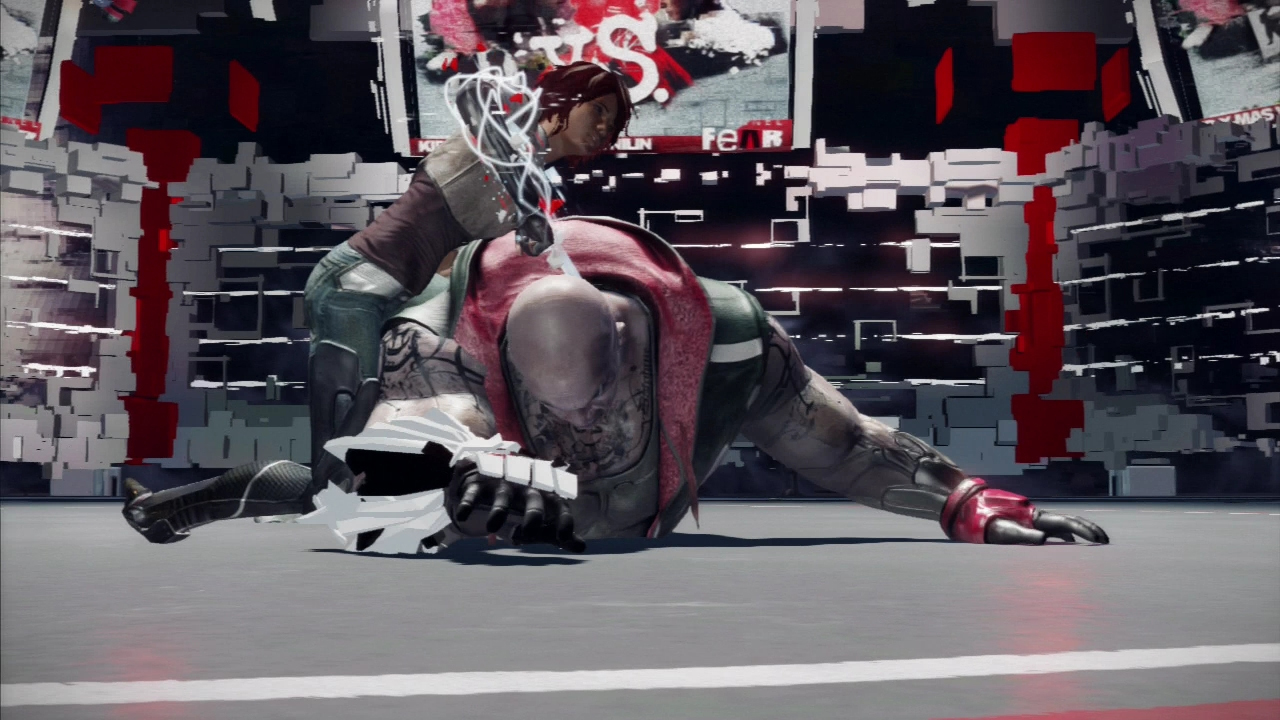
    Special attacks are also a major part of gameplay.  Nilin’s power comes from a sleeve she wears on her right arm.  As the game progresses and as Nilin slowly regains her memory, her abilities increase, ultimately resulting in five special attacks:

    (1) Fury –Nilin has a short rage attack where each hit increases the damage multiplier
    (2) D.O.S. – All enemies are stunned for a brief period of time
    (3) Camo – Nilin becomes invisible for up to 30 seconds
    (4) Logic Bomb – Nilin places a short-fuse bomb on a nearby enemy
    (5) Rest in Pieces – Nilin recruits an enemy drone, which attracts enemies and then blows up

    Along with the Combo Lab, these special abilities make the game experience truly unique – there are countless ways to get through every skirmish, and each gamer will have their own preferences.  And unlike other games, I actually found myself using every ability.  Rather than picking a favorite or two, I found that it was easy and seamless to use them all – each has its own unique way of helping out.

    (3)    Memory Remixes

    image courtesy of weknowgamers.net

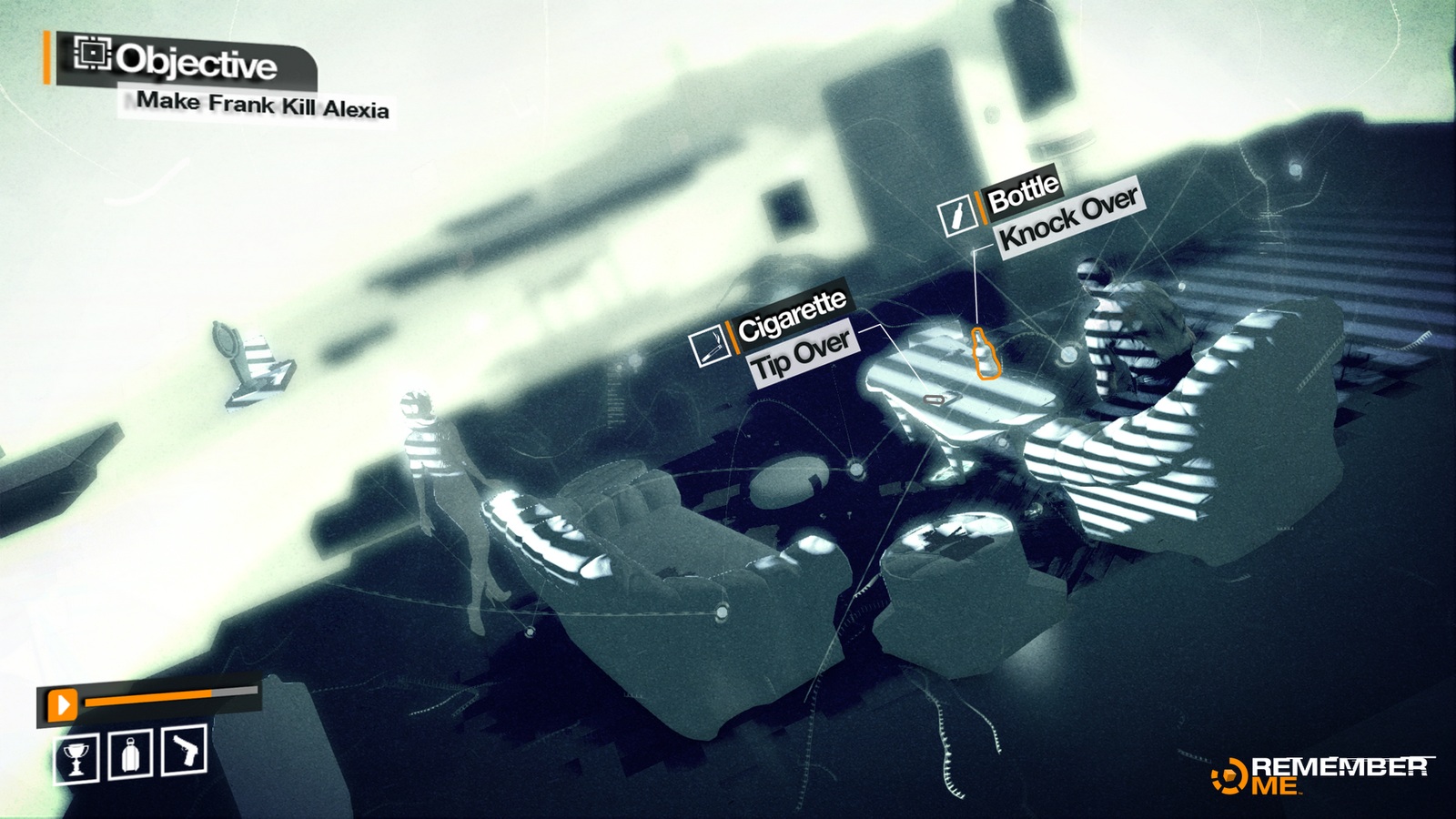
    Memory remixes are by far the most unique aspect of Remember Me.  Nilin uses her powers to enter the mind of her victim and find a strong memory, usually something with a lot of emotional attachment and/or consequence.  The sequence begins with a short cut-scene of the memory as it actually happened.  And then Nilin’s job is to change the end result – something as small as closing a cup-holder, moving a bottle, opening a purse – and your job is to choose the right things to change in order to alter the memory.   And keep in mind that this only changes the memory of what happened, not the event itself.

    I don’t want to discuss the details too much since it is so much fun to figure out on your own.  And if it’s not too late, I would advise not to watch any of the remix trailers – I watched one, and it definitely spoiled the scene.

    The memory remixes, though rare, are a seamless part of the story.  They execute perfectly, and they always make sense.  This is not a game where you will find yourself doing meaningless tasks or wondering why you have to bother with this or that – no, everything you do is important, and it all weaves together perfectly.

    (4)    The Score

    I don’t really have much to say here, except please take the time to LISTEN TO IT.  The score is absolutely fantastic, and I can guarantee that I will own it.  To put that it in perspective, I would like to point out that I have never owned a video game soundtrack before.  This is the first time I have ever taken the initiative to listen to the music separately from the game.

    (5)    The Enemies

    The enemies in this game are truly fantastic.  From the Gollum-type Prowler Leapers to the electrifying Elite Enforcers – there are just enough different types to keep you on your feet, but while still letting you get used to them and learn how they move and act.  By the time you reach the last few episodes of the game, you’ll have met every enemy type and you’ll know how to beat them all individually without taking a scratch.  But then…it becomes a game of strategy.  This isn’t your boring button-masher.  When you find yourself fighting two Brute Skinner Leapers and two Elite Enforcers at the same time, you’ll need to find a very specific strategy if you want to live.  But then if you take away the two Elite Enforcers and replace them with two Seraphims, you’ll have to completely change your tactics.

    [youtube http://www.youtube.com/watch?v=Xa1a1NhHiA0&w=560&h=315]

    Perhaps this style isn’t for everyone, but I loved it.  You know exactly how all of the enemies fight and how to defeat them, but then you have to apply what you know and adjust your strategy every time the circumstances change.  It keeps your mind working, and your mouth grinning.

    (6)    Nilin

    image courtesy of edge-online.com

    I’m pretty sure that I want to be Nilin when I grow up.

    Well…kind of.

    As I said before, I found the story unpredictable and fascinating, and I found that I was always agreeing with Nilin’s choices.  It was like she was inside my head.  Any time I felt doubt about a character or about something she/we had done, she voiced the same doubt.  Any time I felt anger, she did as well.  The writers did a fantastic job of making the player want the same things that Nilin wants.

    Once you play the game you’ll understand the “kind of” from above – Nilin is a great character, but everyone has their reasons for despair…

    (7)    The Achievements

    I enjoy games where the achievements are, well, possible.  I don’t want to have to destroy 39 enemies at one time by clenching the muscle on my left big toe…no, that’s not fun.  Achievements are the most fun when they are actually achievable by the average gamer, and Remember Me handles this well.  Just like any game, there are the regular story line achievements (completing each episode) and the difficulty achievements (completing game on hard), and there are the stragglers — things like defeating a certain enemy in a certain way, or pushing 40 leapers off of ledges (whoa.  say that 10 times fast…leapers off of ledges leapers off of ledges leapers off of ledges…).  Anyways, there’s nothing that I personally feel is impossible, and I believe that this game has just enough replayability that I’ll go back and get all of the achievements.  Since the only games I’ve ever completed achievement-wise have LEGO in the title, I think that this will be a welcome change and a happy addition to my repertoire.

    image courtesy of gameinformer.com

    Unfortunately, all good things must come to an end – let’s look at the negatives.

    (1)    The Sensen and your Environment

    Imagine what would happen if you combined the beautiful landscapes and visuals of one of the more recent Assassin’s Creed games with the boring limited movement you’d find in Prince of Persia: The Warrior Within…and you’ll pretty much understand Remember Me.  The graphics are gorgeous, but you don’t really get to experience any of it.  The game has a specific path for you to follow, and unless there’s a hidden artifact nearby, you have no opinion in where that path should go.  It’s a pretty big disappointment considering that there is so much potential for more.

    image courtesy of dualshockers.com

    Your Sensen has the unique ability of identifying the shortest path to your destination.  The entire game is filled with little yellow arrows, always pointing you in the direction you need to go.  It makes travelling between destinations rather dull.  At one point towards the end of the game, you’ll find yourself in a tall room (maybe 4 stories high), and you’ll have to operate a number of switches and cranes in order to get to the exit.  But rather than create a puzzle for you to decipher, your Sensen leads you every step of the way, even telling you when it’s safe to jump.

    For me, this is one of the biggest disappointments in the game.  There is so much potential for Assassin’s Creed or Uncharted-style platforming, but there was no initiative.

    (2)    The Combat Controls

    Let’s think back to the combo system I discussed earlier.  It’s great that it is so customizable, but I also found that the gameplay was not as seamless as I would have liked.  I would occasionally find myself in the middle of a combo and it would suddenly disappear, leaving Nilin vulnerable to attack until I found my bearings and started again.  I think that there are two main reasons for this issue:

    (1) A combo can only be performed against one enemy; if you are in the middle of a horde and enemy B puts an arm between you and the combo you are performing on enemy A, then the combo is broken and you stumble.

    (2) The button mechanics seems to fail sometimes – for example, I would begin a combo of Y-X-Y-X, but for some reason the game would do a Y attack and then begin the combo as X-Y-X (even if I hit the buttons at the correct times).  So though I may have been hoping for a cooldown combo, I would instead find myself in the middle of a regeneration combo.  Not ideal.

    Though this was enough of an issue to get my attention, I would not say that it really effected my attitude towards the game, or my overall happiness.  The broken combos were few and far-between, so they were never more than a minor inconvenience.   And luckily, the game’s dodge move is seamless, allowing you to quickly evade enemies.  So when your combo breaks at least you can get away easily.

    (3)    The Camera

    Though it was never an issue during boss fights (probably due to the typical large arena size), the camera was sometimes a pain.  If you climb a ladder, it will follow, but then when you get to the top it will remain where it is, looking straight up into the sky.  As a relatively avid gamer, I’ve learned little things about the best ways to control a character – for example, if you’re turning the character to the left and decide to also turn the camera, you usually compensate by adjusting both sticks so that the character does not change direction.  However, there were a few times when I would do this…and the game would just fail to understand.  Nilin would continue to turn to the left even if I had my left stick pointing straight ahead.  Luckily it was a rare issue, and the camera usually cooperated.  But as with the combat controls, it was still annoying enough to gain my notice.

    Those were my biggest concerns and they are really only minor in the long run.  If we are lucky enough to get a sequel, I only hope that environment interaction gets a lot more attention.

    Hopefully this review gives you a good idea of what to expect from the game.  Of course I did not share all of the fun little secrets, since some of the tricks you will learn just shouldn’t be spoiled.  Be prepared for an interesting story and some really fun boss fights.

    image courtesy of cheatcc.com

    I purchased Remember Me for the Xbox 360.  It is also available on PS3 and PC.

    [amazon_link id=”B008XMSRKC” target=”_blank” container=”” container_class=”” ]Amazon.com[/amazon_link]

  • До свидания, Артём – Metro: Last Light Review

    LL Cover

    Before I launch into the review proper, I’d like to ask that you take the time to read my retrospective on Metro 2033. Whether you’ve played it or not, it will help establish my history with the series going forward.

    If you don’t have the time, I’ll paraphrase: Metro 2033 was a completely unexpected surprise, and even though it is flawed, it remains one of the most atmospheric and compelling story-driven games I have ever played. It was a cult hit, but not really enough to warrant a sequel, so I was thrilled when Last Light was announced.

    Metro: Last Light is a true tale of survival in its own right: The sequel no one expected, it somehow managed to stay on track even as THQ burned around it. That is no doubt thanks to the efforts of the team at 4A Games, who had a polished product ready for Deep Silver to get on shelves almost immediately after the acquisition. I will also give credit to the marketing team that brought us the live-action trailers; assuming those were funded by THQ that was money they probably didn’t have to spend.

    From the marketing, both before and after the property changed hands, it was obvious that this game was going to try and walk the fine line between what made 2033 such a hit (atmosphere, nuance, compelling storytelling) and what the mainstream demands (tighter gunplay, bigger set-pieces, more overt storytelling).

    LL D6

    The changes in storytelling are apparent right from the start, with the events of the last game being chronicled for the player in a series of cutscenes narrated by protagonist Artyom. Scenes that took place outside of first-person were rare in 2033, but are more prominent in Last Light. The main plot is also touched upon more frequently; while I don’t want to say it is “spoon-fed,” there are a few characters that might as well have names like Exposition Jones.

    A legitimate reason for the shift in tone, main-plot-wise, is that this is no longer the story of a desperate young man groping his way through the tunnels, coming upon the larger world almost by happenstance. Artyom is a full member of the Spartan rangers now, the enigmatic peace-keepers and trailblazers from 2033. After the discovery of the military installation D6, the rangers made it their base, but word of the spoils in contains has spread to factions like the fascist Reich and the communist Red Line. The ensuing tension and possibility of war intertwines with another (spoiler-heavy) plot thread to form the main thrust of the narrative. As such, it makes sense that this story would focus more on the larger issues and intricacies of the world, since Artyom is now privy to them.

    LL Rangers

    Fortunately, the world is still full of little side conversations and small acts of humanity for you to witness and participate in. I actually felt a little overwhelmed by how busy some of the populated stations were, and know for a fact that a missed some little moments here and there. One of the ways these games gauge Artyom’s demeanor – something which impacts the possible endings – is by how often you stop to listen and interact; statistically, fewer things trigger the system this time, but you never know until after the fact. The guys at 4A really outdid themselves scripting and programming all of them, and it would be a shame to rush past it all.

    Personally, I didn’t care if I was getting “credit” for it or not, because these little moments are so well written and integrated into the world. Beyond just deepening the atmosphere, some of them also provide useful information about your objectives, or where to locate hidden supplies. My personal favorite was watching an old man make shadow-puppets of animals for children. Most of the time the kids thought he was making creatures like nosalis or demons; when he tried to explain the animals that lived before the war, they either didn’t believe him, or got scared by his descriptions. It was a moment of raw humanity and genuine heartbreak.

    LL Shadows

    Easily the best new populated area is Venice station, which was never visited in 2033. “Venice” is not the actual name of the station, but rather a nickname given to it because all of the tunnels around it are flooded, creating a kind of canal system. This obviously means most of the economy is based on fishing, and the station itself is laid out like a bayou shanty town, with several levels of buildings having been constructed around and above the water. Also of note is Theatre Station, so named because it resides under the famous Bolshoi Theatre. It is the cultural hub of the Metro, and Artyom can actually take in a performance there… though the show isn’t what it used to be.

    LL Venice

    Due to the story changes, there are also more instances where you will be in tunnels or stations surrounded by human enemies, and it’s up to you whether you want to run-and-gun or stick to the shadows. New to the series is a non-lethal takedown, which allows you to dispatch guards without making Artyom a murderer; if you or an unconscious body gets spotted, though, all bets are off as the alarm klaxons blare and heavily-equipped reinforcements storm the area. A few changes to the formula keep things fresh, such as one station that is burning around you; this limits your hiding places, challenges you to move quickly, and even forces you to give up on certain routes as they become blocked.

    LL Fire

    That’s not to say there aren’t still plenty of times the player finds themselves alone in an abandoned tunnel, or wandering through the ruins of the city above. Those moments are still present, and still hold ever bit as much tension as they did in 2033. It brings me no shame to admit that I sometimes took a break so that my hands could rest from their white-knuckle grip on my controller. As with any solid genre entry, familiar mutants are intermingled with new monstrosities, such as the aquatic shrimps and the arachnid spider-bugs. Each species also has multiple variations this time around, with standard grunt-types, tougher and smarter officer-types, and even the occasional boss-level behemoth.

    LL Bear

    Unfortunately, there weren’t as many memorable areas that hinged on the dominance of a certain species: The watchmen hoards roaming the DeadCity; the lost tunnels swarming with lurkers; the minefields of amoebas in D6. Finally, nothing in Last Light comes even remotely close to the experience of the Library, and the terror and tension of trying to keep line-of-sight with the hulking librarians even as they charged at you. Even the boss fights are all variants of the familiar “big baddie in a semi-circular arena” fight, with a slight environmental or mechanic twist throw in.

    I know anyone familiar with Metro 2033 will know that one of the main complaints was the gunplay, and is probably waiting for me to talk above whether or not it has improved. The thing is, I never had any issue with the gunplay in 2033; it doesn’t play like a Call of Duty or a Battlefield, but I never got the impression it was supposed to. These aren’t the well-oiled, super-sleek, camo-customized weapons of a twitch shooter; these are well-worn, battle-scarred, hand-me-down tools of survival.

    LL Weapon

    Each gun still feels like it fits well within the world and the game; each one has its own pros and cons, handles differently, and is perfectly suited to at least one combat approach. I think you could probably tell a lot about someone’s Metro experience by asking them what weapons they favored for the majority of the game. Personally, I opted for the following:

    • A silenced “bastard” machine gun with and extended stock and an IR scope, perfect for shooting out lights and tracking patrols in the dark.
    • An AK with a reflex sight, laser dot and extended magazine for when the quiet approach wasn’t an option against human targets.
    • A sawn-off, quadruple-barrel shotgun with both stock attachments for accurately turning charging mutants into little, scattered bits of flesh and bone.

    Overall, there are at least a dozen weapons at your disposal, ranging from more refined military hardware, to jury-rigged, gas-powered weapons of necessity, to truly unique items like the helsing. Each weapon is customizable, with slots for barrel, optics, stock, and miscellaneous additions; thankfully, except for on instance after what is essentially the tutorial level, the game doesn’t ever permanently strip you of your hard-earned gear.

    While I didn’t think the weapons handled noticeably different from 2033, you are presented with a few more situations where combat is 100% the focus of the area. In addition to the aforementioned boss fights, there are a couple of hold-the-line scenarios as you wait to be able to access the next area, and a few times you find yourself surrounded by enemy troops who are already alerted to your presence. The game’s climax in particular is about as action-packed as you can get, and I’m sure will be seen by some as a total sell-out to the mainstream shooter crowd. Of course, there is an achievement for completing the game without a single human kill, which means the developers are challenging us to avoid the carnage even as their level designs steer us into its path.

    LL Combat

    I do have issue with some slight changes to the user interface, and the visibility of weapons in the field of view. Several gear items that had a dedicated button in 2033 are now relegated to sub-menus that pop up when a certain button is held; additionally, weapons and gear have been split between two such menus, yet the gear menu still feels crowded. More than once I switched my secondary weapon while trying to replace the filter in my gas-mask or charge my flashlight. I was also disappointed that throwing knives became a secondary weapon, meaning that we no longer get the physical presence of Artyom’s hands when trying to line up shots with them.

    There were also changes for the better, especially when it comes to the gas mask and its filters. The system for tracking how much time was left while using the filters was much improved, and the mask as a whole had a more immersive presence while being worn. There’s even a button for wiping water, mud, and gore off of the visor, and I sometimes pressed it for fun just because the attention to detail was that cool. I also loved the ability to use my lighter and gun at the same time, and frequently utilized it as my primary source of illumination; the fact that it burned away cobwebs and could light the occasional torch or lamp was just an added bonus.

    LL Lighter

    All of these things combine to make a game that is a sequel to 2033 in literal terms of continuing the story, a spiritual successor in terms of continuing to craft and refine this universe, and feels almost like a reboot in terms of the approach to the combat experience. The resulting Last Light experience is very reminiscent of its predecessor: It gets the majority of things right most of the time, absolutely nails it all here and there, and despite a few fumbles the whole thing comes together nicely. The atmosphere and ambient storytelling I adored are still present, even if set against a revised backdrop, and I have no doubt that this isn’t my last time taking this particular journey with Artyom.

    I don’t know that I can say which game I liked “better”; my preference for one at any given time could probably be attributed to my mood. I think a fitting comparison would be the differences between feeling like watching Alien and watching Aliens. 2033 is a lonely game, one filled equally with quiet moments of reflection, moments of raw terror, and moments of wonder at the world Artyom never knew lay beyond Exhibition station. Last Light is more populated, its reflective moments more observational than introspective, its tension driven more by human machinations, and its potential stakes are higher.

    LL Hope

    Last Light is very much a game that will give back as much as you put into it, for better or for worse. Artyom must decide whether the dark ones, mutants, and other factions are hostile and a threat, or simply misguided and misunderstood; so must we decide what the Metro can do for us, or will do to us. In the end I can’t help but feel like we are all watching shadow puppets on the wall. What you choose to see in them is up to you.

    [amazon_link id=”B0053BSN82″ target=”_blank” container=”” container_class=”” ]I played Metro: Last Light on the XBox 360; it is also available on PC and Playstation 3.[/amazon_link]

  • Enter the Dragons – Trey’s Far Cry 3 : Blood Dragon Review

    FC3 BD Box

    If you haven’t had the chance to play Blood Dragon yet, or if you have but missed the live-action launch trailer, I am going to ask that you take the time to view the trailer posted below. Just trust me on this. Thanks.

    It’s brutal honesty time: If that trailer stirred nothing within you, this game is not your thing. I say that now because the review below might make you think otherwise, so don’t come crying to me if you decide to pick it up and are then disappointed. I warned you.

    For those of you who did “feel those feels” so to speak, Blood Dragon may be the best $15 you spend this year. It is everything that trailer would lead you to expect on the surface, and surprisingly more underneath.

    The game stars Rex “Power” Colt, a Mark IV cyber-soldier who has been sent with his partner Spider to investigate a mysterious island base. Of course, things go horribly wrong, and Rex is forced to work with the beautiful (but mysterious) Dr. Darling to try and stop Sloan, his former CO and mentor who has gone off the reservation.

    FC3 BD Cutscene

    The story is told via animated scenes straight out of something like Contra or Double Dragon; the characters are just static drawings that slide back and forth or change position suddenly whenever they are supposed to be “moving.” Did I mention these scenes are intentionally scaled to only take up about 1/6 of your screen, and use 16-bit color?

    Gameplay, on the other hand, is rendered using the full Far Cry 3 engine, albeit a tweaked version of it that makes everything look like a mix between Tron, LV-426, and the Terminator future. The lasting effect is a mixed bag of drab environments that lack the stunning immersion of FC3, versus objects that pop nicely against this backdrop so that every enemy, animal, vehicle and item really stands out for the player. The game world is admittedly rather dark, and my first play session left me with a headache as my eyes adjusted.

    FC3 BD Enemies

    One of the surprises the game had for me was just how much time I would spending with it, because after the initial mission and a brief tutorial on base-capturing, the island opens up to you just like in FC3. There aren’t any radio towers, but there are a dozen bases for you to capture, two types of side-quests, animals to hunt, and three types of collectibles to search for. I was genuinely pleased that this wasn’t a straight action game, and roaming the land is every bit as much fun as it was in FC3.

    The base capturing works a little differently, mainly due to the presence of the titular blood dragons: Creatures of unknown origin, these dinosaur-sized, neon glowing mini-Godzillas roam the island at will. They will make a bee-line for you if you don’t move quietly around them, but their roaming can be controlled by luring them around with cyber-hearts taken from your enemies. They are immensely hostile, and can attack with tooth, claw, and lasers from their eyes.

    FC3 BD Dragon

    Each enemy base has shields around it that keep dragons out, but you can lure them close enough to use their lasers, and keep enemies distracted long enough to sneak in and turn off the shields. Once that happens, it’s just a matter of watching the dragons kick ass until the base is clear, at which point you need to either kill them or lure them back outside of the shields to take the base. I usually opted to lure them out, mainly because I saw them as allies, but also because they’re hard as shit to kill until you get a few of the late-game weapons.

    For the side missions, Path of the Predator makes a return; go here, get a certain kind of weapon, kill specific enemy / enemies with that weapon. The other type is a hostage rescue, where you have to kill all of the enemies in a certain area without being detected, otherwise they off the hostage. The collectibles are appropriately themed: there are VHS tapes with spoof descriptions of 80s classics; TV sets that are tuned to a strange, static-filled signal; and research notes about the crazy things Sloan’s lead scientist is trying.

    screenlg31ll8m-noscale

    One of the complaints with FC3 was that there were simply too many random tasks that didn’t really contribute anything to the experience. Blood Dragon corrects this issue by having all of your weapon attachment unlocks tied to the side missions and collectibles. Think running around finding TV sets is boring? Find enough of them and you unlock a double-barrel, and then a quad-barrel attachment for your shotgun. The system isn’t perfect; for instance, all four upgradable weapons have three capacity upgrades, which is a bit much. I would suggest taking the time to find everything before completing the game; otherwise some of the cool attachments you get will never see any real use.

    Adventuring around the island will also earn you cyber-points, known in other games as “experience.” Blood Dragon retains a lot of them same perks and skills as FC3; instead of branching skill trees, each level-up simply unlocks a new ability, bumps your max health, etc. So though Rex doesn’t feel quite as hand-crafted a killer as Jason Brody, the end result is that you slowly become more and more bad-ass without having to fret with menus.

    screenlg56kaag-noscale

    When you finally do get around to the story missions, you will be treated to five of the most action-packed, sharply-written action movie parodies imaginable. I thought deeply about how much to talk about the one-liners, references and twists that pop up as you progress, and decided that it’s all just too good to spoil. I will say that the second-to-last mission is the hardest part of the game, but it opens up and ability that makes the last mission pure joy. You know how action movie heroes get their ass kicked in the second act, but then after a montage spend the entire third act killing 10x the number of enemies that previously whooped them? It’s that, and then some, and about halfway through that last mission… Well, no spoilers, but I was literally laughing while wiping away tears of joy.

    http://www.youtube.com/watch?v=xH4UwdS5sPE

    There are not a whole lot of reasons to stick around after the credits roll, other than to grab a few missed collectibles, or maybe tackled the task of killing 25 dragons, but I was still supremely satisfied.  It seems that more and more companies are using downloadable titles as a way to let dev teams do cool, off-the-wall ideas, and Blood Dragon is the epitome of the trend so far. If you have $15 and a free weekend, then you have what it takes to do it “Mark IV style, mother(@#^er!”

    I played Far Cry 3: Blood Dragon on the Xbox 360. It is also available for download on PC and Playstation 3.

  • Review: Star Trek: The Video Game

    Photo courtesy dapsmagic.com
    Photo courtesy dapsmagic.com

    Set Phasers To Meh

    I am a lifelong Star Trek fan. Not a bandwagon since 2009 when J.J. Abrams made it cool to like the adventures of the Starship Enterprise. Now do not get me wrong, I absolutely loved the 2009 reboot and applaud everyone involved for making Trek accessible to a whole new generation. Now, this summer we will be getting the much anticipated follow-up, Star Trek Into Darkness, and with that comes the dreaded words….movie tie-in game.

    I first saw footage of Star Trek at E3 two years ago and was generally excited about what I saw. A buddy co-op space adventure starring Kirk and Spock with influences coming from the Mass Effect series and Gears of War, two of my favorite franchises ever. The game was set for release in 2012, but was given a whole extra year of development time to coincide with the release of the movie sequel. I made the mistake of thinking that this would help the game become more than the run-of-the-mill movie game and yet here we are, in 2013, with exactly that.

    Star Trek is set after the first film (obviously), but it does not bridge the two movies. For that you will need to pick up IDW’s four issue mini-series, Star Trek: Countdown to Darkness. The game plays out as more of an extended episode of the series with the new crew. One long, long episode. All the good will that is built up in the first hour or two of play is wasted when the story stretches out way farther than it needs to. By the end, you are wondering exactly how much longer you will have to pry open one more door, hack one more door lock or fall off a ledge from the game not reading your jump command.

    Photo courtesy uverseonline.att.net
    Photo courtesy uverseonline.att.net

    Gears of Kirk? Spock of War?

    Star Trek has you choosing to play as Kirk or Spock at the beginning of the campaign, but I never really saw much of a difference in the two. The makers have said that Spock was to be played as more of a logical, stealth option while Kirk a headstrong, shoot-first type. In theory, this sounds good, yet it is not actually implemented in the game. You have the option of stealth during multiple missions and it doesn’t matter which character you are playing as to do it because once the shooting starts both you and your A.I. partner have a license to kill.

    The main plot involves a Vulcan scientist who has created a source of energy called the Helios device which will aid the Vulcans in the creation of New Vulcan. Due to sabotage, the device opens a rift in space which allows creatures known as the Gorn to pass through. These creatures appeared only once in the original series in the famously cheesy fight with Capt. Kirk.

    Give Uncle Scrotor a hug
    Give Uncle Scrotor a hug

    But now they have been given a modern makeover and appear much more dangerous. You will find many different variety of Gorn to fight like the green Gorn, red Gorn, blue Gorn and multicolored Gorn. Sensing a theme here? One of the main problems with Star Trek is the complete lack of enemy variety. Now you will have some levels that have you fighting infected Vulcan or Federation officers where you stun them and choke them out, but the majority of your time is spent obliterating one lizard or another. Now I know this is the essence of every shooter, but at least with games like Gears of War there is enemy variety. The Gorn are literally different colors with different weapons.

    Cover mechanics are not bad or good, they are mostly serviceable. There is no melee attack to speak of unless you stun your enemy first making for some weird situations when you have someone running up on you and you can not quick fire to hit them. Don’t expect to melee them back, just run away, turn around and fire again. There is an attempt to have an upgrade system for health, tricorders and weapons, but it is rudimentary at best. You use your tricorder to scan your environments for alien plant life, audio logs and new enemy types to add to the data log which gain you XP. Spend as you wish on phaser upgrades or tricorder abilities like healing your partner. The useless part of this is that you can easily beat the game without upgrading one single item.

    The Voice of Reason

    The two aspects of Star Trek that truly do excel are the music and the voice work. The music takes pieces of Michael Giacchino’s 2009 soundtrack and mixes them well with new samples that work very well in the Abrams reboot universe. The voice acting is also on the good side. Chris Pine seem to be having fun voicing a video game character and his Kirk is just as cocky and headstrong as his cinematic counterpart. Zachary Quinto’s Spock is equally up to task and there were multiple moments where his interaction with Kirk was very enjoyable and worthy of the movies. The rest of the cast is here as well including Simon Pegg, Anton Yelchin, Karl Urban and Zoe Saldana. Sadly it sounds like Saldana read her lines at gunpoint with someone telling her to sound as disinterested as possible, kind of like her role in Avatar.

    Photo courtesy jjplace.com
    Photo courtesy jjplace.com

    Star Trek has a lot of good ideas and ambition that never comes to the surface. You can tell the influences that drove the game throughout, but it never gets past mediocrity. The sections on board the Enterprise are a bit of fun and the voice acting is a treat (except for you Zoe) while the music is too good for the product it is attached to. If they could have tightened up the controls and cut a couple of hours of the blah plot, Star Trek could have been better than average. It overstays its welcome and the final few hours are spent on bland looking alien ships that test your patience. If you find this in a bargain bin for $20 and are a Trek fan, by all means pick it up, but for a full priced $60 title, there is a lot left to be desired. As melty as I get over Chris Pine’s voice, it is not worth the price of admission.


  • Review: Injustice: Gods Among Us

    Photo courtesy segmentnext.com
    Photo courtesy segmentnext.com

    All’s Fair In Love And Killing Your Wife

    Things are bleak in Injustice: Gods Among Us, the newest fighter from Mortal Kombat developers NetherRealm. How bleak you may ask? Oh, just that Lex Luthor has given The Joker a nuclear bomb that he uses to completely obliterate Metropolis. So you think that would naturally piss off Superman. Were not done yet. The Joker also drugged Supes into thinking that Lois was Doomsday so he flew her out into space killing her and his unborn child.

    Damn. Cold blooded.

    So naturally Superman loses his freaking mind and does his best impression of Indiana Jones and the Temple of Doom and rips out The Joker’s heart.

    Kali Ma. Kali Ma. Kali Ma.

    Wait…I hear you saying. I thought this was a fighting game. And you would be correct. Injustice has a full-fledged story mode like 2011’s Mortal Kombat and it is simply fun as hell to play. Crazy Superman has taken over the Earth and is forming it to the crime free society he desires…by any means necessary.

    Don’t worry this is a comic book story so there is multiple dimensions to save the day!

    Batman from batshit crazy Superman dimension transports Justice League members over to his version of Earth to fight the tyranny of Superman. You will play as the majority of characters in the story mode and each section will give you four or five fights per character making the story mode the most entertaining way to learn a lot of fighters ins and outs.

    There are 24 characters that make up Injustice’s roster and that is not including the four additional fighters coming in future DLC. The variety that NetherRealm threw in the game is refreshing. Sure, you are going to get your DC mainstays like Superman, Batman, Green Lantern, Lex Luthor and The Joker, but they have featured characters that do not normally get very much time in the spotlight except to lifelong comic fans. Hawkgirl, Ares, Black Adam and Raven are not household names and NetherRealm has done a wonderful job making these “lesser” characters feel like they not only belong with the big boys, but can handle their own against them.

    Injustice02
    Photo courtesy gigaventure.com

    Hi, I’m Batman. I Will Be Punching Your Face This Evening.

    Combat in Injustice feels a lot like 2011’s Mortal Kombat and that is a good thing. NetherRealm created a good combat engine and they transferred that here while tweaking a few of the collision issues. Controls are boiled down to three buttons for attacks and a fourth for a hero’s special ability. This could be anything from Batman calling in three explosive floating bat-bombs to Aquaman creating a water based shield around his costume to reduce damage for a small amount of time. These abilities regenerate after a few seconds and can help to extend combos in some cases and add a new small layer of strategy to each fight.

    Character special moves have very different feels to them for each character and fits the personality of each fighter well. Aquaman uses his trident, The Joker has his Jason Todd-killer while The Flash uses his super speed to whip you into shape. Playing through each of the characters in battle mode (your normal MK mode where you make your way through ten different fights in a row) will yield some pleasant surprises. This is the best mode to learn every aspect of a fighter, especially ones not playable in the story. You can not simply learn a character fully without spending time with multiple fights. Going outside your box of favorites may have you developing a new found fondness for a hero and villain you never thought would grab your attention. When I left my Superman, Batman and Green Lantern and began to focus on other characters I found just how awesome and varied that attacks were. Before I knew it I did not want to move away from Green Arrow, Ares, Shazam and others.

    NetherRealm has absolutely loaded Injustice to the brim with so many modes, extras and unlockables. When you find yourself past the story mode and even after you have blasted through battle mode with all 24 characters there are the S.T.A.R. Labs section. The S.T.A.R. Labs will have you taking control of all 24 heroes and villains in mission based fights or mini-games. There are 240 missions total and each one comes with a star rating of one to three. Each fight has a set of parameters to meet and you receive a star rating depending on how well you do. The more stars you earn, the farther you can go into the S.T.A.R. Labs. Some of these can be easily attained and some of them had me wanting to kick my television in the face. That, to me, is the sign of a good fighter.

    Photo courtesy polygon.com
    Photo courtesy polygon.com

    Let’s Get Interactive

    There are a total of 15 arenas to choose from in Injustice and all of them have a list of interactive objects to use during your fights. These make the game feel truly more like a fight in the comic world than anything else. Want to hit your opponent with a motorcycle outside of Wayne Manor? Go for it! Roundhouse kick them Chuck Norris-style into Aquaman’s throne in Atlantis? Go ahead, Texas Ranger. Things get violent on an even bigger scale when you obliterate opponents through walls setting off an unfortunate chain of accidents which lead to another arena.

    http://youtu.be/ZFwZd-Ur1_A

    With every fight, no matter what mode you are playing in, you will gain experience points allowing you to level up. As you progress upwards you will begin to gain access code cards which you can spend to unlock character costumes and loads of other goodies. Character cards, booster packs and even unlockables that link from the Injustice iOS game that ensure if you want to 100% this game, you will be spending a lot of quality time bashing in Sinestro’s face. Do not take this for a simple fight ladder type of game. There is real depth here.

    Make no mistake, Injustice is NO Mortal Kombat vs. DC Universe. NetherRealm has taken the best things from 2011’s Mortal Kombat including an engaging, multi-dimensional story and given comic fans a true fighter that is a worthy successor to MK, but also (hopefully) a mighty new franchise. The sheer amount of modes and extras to unlock is a bit mind boggling. I applaud the developers for taking a chance and not simply churning out a Mortal Kombat sequel (which I would not be against by the way), but taking a different avenue. Comic fans and fighting game fans will be hard pressed to find something as fun…until Lobo is released as DLC that is.


  • Scott’s Review: Bioshock Infinite

    bioshock-infinite-box-art-slider-2

    I will just go ahead and be honest with all of you right now. As I sit down to write this review I am having trouble finding the exact words to begin to describe Bioshock Infinite. I mean that in the best possible way of course. As my brain processes all of what I experienced in the city in the clouds named Columbia, I begin to have that same sense of wonder that I was left with after I played 2007’s Bioshock with one significant difference: Bioshock Infinite took everything I loved about the original and improved it greatly while adding what is easily the best written story of this gaming generation.

    Now before we begin I want you all to know that this will be a spoiler free review, so have no fear while you are reading along. I will take the more difficult road and temper my want to just expose everything I discovered in this game because I love all of you. That is not to say that me or my fellow colleague, Trey Sterling (who will be reviewing the game also), will not have a later article discussing the complete epic mindfucks that happen in this game, but not today and not here!

    Pitch Perfect

    You begin the game as Booker DeWitt, a man that has led a life that has been quite unsavory. He has fallen in deep with the wrong people and has agreed to take on a peculiar job in order to clean his slate. You are being led out to a lighthouse in a roaring storm on a boat being rowed by two strangers. A lockbox is handed to you with a photo of a girl and other items. The message is very clear as to what your job is. Bring them the girl and wipe away the debt.

    Once you reach the lighthouse, you make your way inside and are greeted with a basin of water to wash away your sins and biblical sounding messages framed on the wall. You make your way to the top and sit in a chair when when walls begin to close around you. Sound familiar? Instead of burrowing your way down into the underwater city of Rapture, you are rocketed skyward and when you break through the clouds you are treated to your first view of the floating city of Columbia. After landing you make your way into the city via unusual means and your adventure begins.

    One of the many, many things that Bioshock Infinite does right is that you are given ample time to explore and fully take in how fully realized the city of Columbia is. Citizens live their lives as you walk among them. They have conversations while kids play in the streets. Shops occupy not just business sections, but also, some float on there own and connect with other parts of the city to give patrons a chance to peruse their stock. You can walk up and view other floating parts through telescopes placed around. It is every bit as memorable as the first time you stepped foot into Rapture only this time instead of a cold, dead society you are greeted with a warm, lively version of 1912 America. Take your time and enjoy the quiet serenity, because it does not last.

    The proceedings take a sudden and very racially charged turn and before you know it you are enemy number one floating thousands of feet above the ground with no where to go except towards your cargo. When you first begin combat it will feel very familiar to the original Bioshock with one noticeable difference being the Skyhook. The Skyhook is a spinning hook that is wearable on your left hand and is used in transporting yourself around the city on the sky rail system and also as a vicious melee weapon. You also have a pistol, your health bar and your vigor gauge (which takes the place of plasmids). You begin with a simple possession vigor which can be used to take over turrets in your favor and even other humans and have them attack others. Vigors are refilled with salts which can be acquired through bottles, vending machines and various other loot items found throughout the world of Columbia. As you begin the game, you will feel a sense of trepidation when using vigors, but have no fear, you can upgrade them as well as your health and shield (new to the Bioshock series) by finding infusions scattered throughout.

    There are eight total vigors in Bioshock Infinite and they will be familiar to fans of the series, even with the new names. My personal favorites were Murder of Crows and Shock Jockey, especially when used in conjunction with each other. Shock Jockey is, of course, an electric field you shoot out of your hands Emperor Palpatine-style and Murder of Crows sends out a Hitchcock-like swarm of birds to eviscerate your enemies. Devil’s Kiss send out a fiery ball to set men ablaze while Return To Sender catches enemy projectiles and lobs them back. I won’t go through every one of them because I want you to have the pleasure of discovering them and finding out all the unique combinations that are possible.

    BioshockInfinite1

     Tear Columbia A New One

    Just as the combat experience in Bioshock Infinite begins to feel like you might be in for a repeat of the previous adventures to Rapture, you are introduced to Elizabeth. She is the daughter of Columbia’s founder, Zachary Comstock, and the girl you are supposed to bring back from Columbia to wipe away your debt. She is trapped away in a monument and been carefully watched her whole life by the scientists and zealots of Columbia, but why? Why does Comstock keep his only daughter locked away from all outside interference and have literary propaganda thrown about the city promising she is the future savior of Columbia? Perhaps the fact that she can tear open the fabric of time and space to see anything she wishes in any time period. Yeah, that would do it for me too.

    When you rescue Elizabeth from her tower prison you discover she has been protected and cared for by a huge, mechanical creature called the Songbird which you should know if you bought the massive $150 collector’s edition. He will make occasional visits to screw up your journey.

    Once Elizabeth joins you in your escape from Columbia, this is when combat fully opens up and separates itself from the original Bioshock. You don’t have to worry about this being one big, long, annoying escort mission. Elizabeth can take care of herself and before the game reaches its completion she will have saved your sorry ass more times than you can count. She is always readily on hand and ready to toss you anything you happen to be lacking during the many frenetic gunfights you will encounter. You will see a prompt come on screen and Elizabeth yell at you and simply press the corresponding button and she will supply you with health, salts or ammo. I will warn you not to become overly dependent on this though because there will be times, especially during lengthy battles, where she will run out of supplies. So don’t get cocky and expect her to always come along and pull you out of the fire.

    bioshock-infinite-machine-gun

    The biggest addition to combat in Bioshock Infinite is the fact that Elizabeth can open tiny tears in space and make available to you new ways to get the better of the people hunting you down. She can summons sentry guns, mosquitoes (floating automated machine guns), walls for instant cover, medical stations and even skyhook connections that allow you to get the higher ground in a hurry. You may consider yourself a Bioshock expert with your learned use of weapons and vigor combinations, but it is the mastery of those two things and Elizabeth’s abilities that will truly make you feel like you are a badass. You could play through this game over and over again and no two battles will ever be the same. Do you take cover behind a wall created by Elizabeth and use your vigors and weapons like a cover-based shooter? Have her create a skyhook connection and get to higher ground, rain down some Shock Jockey then take out a few guys with your sniper rifle? Have her summon a patriot and as your enemies are focused on him, sneak around and flank your enemies? My brain is literally spinning right now trying to remember just how many different variations I used and all the new ways I can try on my next playthrough.

    A quick word to the wise when it comes to upgrading your abilities: build up your shield first. The shield is new to Bioshock Infinite and is a life saver on many occasions. It will regenerate unlike your health so getting this to maximum quickly is a very good idea. I actually upgraded my health last after my shield and vigors. My shield recharges and I can find food everywhere for small boosts until I could find a vending machine for a refills. I used my vigors almost constantly so upgrading them second just made sense so I could have more uses of my powers.

    Enemies in Columbia range from meh to memorable. In Rapture you were truly freaked when you came across splicers for the first time or when you watched the Big Daddy lumber by on the other side of the glass. Columbia has a wide range of enemies, but none really jump out at you…with the exceptions of the Handyman and Boys of Silence. The easiest way to describe the Handyman is to think of the big badassery of the Big Daddy and let him run fast and jump far so he can be all up in your face before you know it. The Boys of Silence are only used in one area of Columbia, but it is more than memorable. You must remain unseen or they can call in an army of dead creatures. Believe me, after one time, you will quiet the hell down. The other members of the rogues gallery like firemen or soldiers do not give you the same feeling as the denizens of Rapture. They feel more like cannon fodder.

    bioshock-infinite_screenshot

    Infinite Possibilities

    This is the hardest part of my review to write. I have to convey to you how truly amazing the story is without possibly giving away anything. Bioshock Infinite could be called many things. A look back on the racial tensions that has marred this country for generations. An indictment on American culture today when it pertains to the working class and the one percent. A look at family and how the dreams of parents for their children are not always what is best for either party. Bioshock Infinite is layer after layer of storytelling and as you delve deeper into Columbia you may think you have a grasp on what is going on, but you truly have no idea. There is one event about 85% into the game where you believe a big reveal happens and you begin to think that maybe your idea about the ending was a bit muted and disappointing and you, like me, will be completely wrong. I promised a spoiler free review and dammit that is what I am going to do, but I honestly have to tell you that the last thirty minutes of Bioshock Infinite left my jaw agape and my controller nearly slipped out of my hands. I can not stress enough that you should let no one ruin the end of this game for you. This is coming from a cynical bastard that does not care about spoilers. Don’t do it.

    You should know that the skyhook system does not make this game into a huge open world adventure. Now that is so minute that it should not register when weighed against the overall incredible feeling of this game, but I feel that I need to let you know that. The skyhook is used in combat (amazingly) and it is used to funnel you betwen areas, like a fancy ass tunnel system from Batman: Arkham Asylum. You can go back and forth between areas as you want for side missions and what not, but don’t go into Infinite thinking you are going to be getting Bioshock: San Andreas. I am pretty sure if you are playing Infinite then you are familiar with the structure of the original Bioshock, but I had to put that out there for new adopters.

    I can not say enough about the experience that is Bioshock Infinite. I have tried to explain how you immediately get lost in the world of Columbia and how smooth and free-flowing the combat is, yet there is no real way to truly put into words just how deep, emotional and satisfying this game is.

    What Ken Levine and the team at Irrational have been able to craft with Bioshock Infinite is nothing short of awe inspiring. If you thought you got lost in the immersion of Rapture then you haven’t seen anything yet. It is a one of those surreal experiences of gaming bliss that only comes along a few times in a gaming generation. Bioshock, Mass Effect, Uncharted 3, all these belong in the same company. Bioshock Infinite should be held higher than all of them. It has taken everything that was good about Bioshock and made it great. That alone should tell you exactly how wonderful a game we are dealing with here. Then add to it that it also improved what made Bioshock great, adding in the greatest story of this console generation, and what you are left with is gaming history.

  • Will the Circle be Unbroken: Trey’s Review of BioShock Infinite

    468px-Biotop2

    When BioShock came out in late 2007, it was an instant commercial and critical success, and raised the bar exponentially for story-driven FPS. Its influence can still be felt, with the most recent example of its progeny probably being the excellent Dishonored.  The game had a few shortcomings, of course, as anything made by humans tends to. Even the mighty Ken Levine felt compelled to include an unfortunate “final boss,” a fight which culminated in what may be the single most anti-climatic ending of modern gaming. But taken as a whole, BioShock was a singular and arresting masterpiece.

    Business being what it is, publisher 2K immediately wanted to get rolling on a sequel, something which Levine and the team at Irrational Games agreed with… at first. Issues arose when 2K wanted to rush the studio’s (admittedly lengthy) standard development process, and were further compounded when it was determined the game “needed” a multiplayer component. Irrational departed the project to work on a “true” successor, and BioShock 2 was released to middling scores; arguably the game’s most interesting feature was the laundry-list of development teams featured in the opening credits.

    Fast-forward to August of 2010, when Irrational used the tease of “Project Icarus” as the lead-in to Infinite’s reveal trailer. Eager players got our first look at Columbia, an almost complete inverse of Rapture: A city among the clouds, founded on the principles of American exceptionalism, racial purity, and religious fervor. We were also introduced to the game’s central plot: You were trying to rescue a young woman with special abilities from this city, with things apparently bigger and badder than even Big Daddies trying to stop you. Unfortunately, the initial release date of “October 012” eventually became March 26, 2013 owing to Irrational’s aforementioned penchant for taking their (sweet-ass) time.

    Alright, I promise the history lesson is done, and apologize to anyone who was already well-aware of that information. I chose to include it, however, to make a point: Very few games have ever had this much hype to try and live up to. Hell, just go give my “Five Reasons” article another glance and you’ll understand just what this game had to leave up to for my expectations, alone. I want to establish these things so that when I tell you the final product met and exceeded my desires in almost ever area, you get a feel for just how good this game must be.

    The opening lighthouse-centric portion of this game is, if anything, even more mysterious than the plane crash that launched BioShock. You’re Booker DeWitt, a former Pinkerton agent turned private eye / “independent contractor” who is being sent… somewhere in order to retrieve a young woman named Elizabeth. The game doesn’t give you much to go on, except that Booker has fallen in with some bad sorts, and he needs to “bring them the girl to wipe away the debt.”

    I won’t spoil your initial arrival in Columbia, but I will say that Infinite begins at a much more easy-going pace than its predecessor. Depending on how much time you spend looking around, there’s almost an hour worth of simply wandering around Columbia; you can listen to a barbershop quartet, watch fireworks, and play games at a carnival. (Appreciably, the carnival games are actually tutorials on some the weapons and abilities.) You’re slowly making your way toward “Monument Island,” a giant statue of a winged girl where Elizabeth is being held. Everything is going well until someone notices the letters “A.D.” scarring the back of your hand.

    handyman-bioshock-infinite-1024x576

    You see, Columbia is ruled over by Zachary Comstock, also known to the residents as “The Prophet.” Comstock claims he was given a vision from an angel, and Columbia was the result. Apparently Elizabeth is his daughter, born under miraculous circumstances to his now-deceased wife, who was supposedly murdered by the “Vox Populi” labor rebellion. Elizabeth is now known as the “Lamb of Columbia,” though the Prophet has seen that a “false shepherd” will try and lead her astray.

    A false shepherd who happens to have the mark of “A.D.” on the back of his hand.

    From there, the idyllic sight-seeing turn into a full-fledged fight for survival, as the Prophet employs ever-increasing measures to try and stop you. Your first two acquisitions are a sky-hook and an ability-enhancing “vigor” (plasmids from the first game) that allows you to posses enemies. The sky-hook serves as both your melee weapon and gives you the ability to use freight hooks and sky-rails to move about the environment. As such, the player understands from these very first fights that combat in Infinite is about mobility, using your environment, and creating ways to keep focus off Booker when possible.

    It’s here that I want to avoid talking too much more about the story, except to say that Booker does eventually reach Elizabeth, and from there they get swept up into the larger conflicts of the city. There’s the aforementioned Comstock and his other “Founders” Cornelius Slate and Jeremiah Fink, who are the heads of the city’s security forces and manufacturing, respectively; Daisy Fitzroy, the former servant and Vox leader accused of killing Lady Comstock; Robert and Rosalind Lutece, a pair of twins who appear to be involved in Booker’s mission and have connections to Comstock; and finally, the Songbird, the mechanical being assigned the task of both caring for Elizabeth and keeping her under confinement.

    Elizabeth is probably the main reason I looked forward to each play session. It is evident from the first time Booker sees her – under circumstances where she can’t see him – that we are intended to love her, though not necessarily in a romantic or sexualized way. Her captivity has made her both naïve and world-weary. The first thing she does upon escape is to join a group of people dancing on a pier, and it seems she could do that indefinitely and still be happy; at the same time, her desire to escape has made her an expert in lock-picking and cryptology.

    bioshock-infinite-elizabeth1

    While held captive physically, she has been afforded every opportunity when it comes to education: We see her painting, dancing, and singing; she seems to be exceptionally well-versed in the arts and the sciences; there is reason to believe she is multi-lingual; and even though she can’t leave her tower, she can see outside and beyond it through her use of “tears.” In a nutshell, tears are windows into other points in time and space, such as Paris in 1983, or a Kansas farm in the middle of a tornado. This ability has been studied and exploited over the years; for instance, Fink uses it to discover new items for his factory and has his brother produce songs based on music he hears through the tears.

    Comstock has been using a device to limit these powers, but once freed of her tower, Elizabeth slowly grows stronger in ways that become exceptionally useful. Initially, she is able to bring small changes in from other versions of Columbia, such as a box of med kits or an automated gun turret. Balancing which tear to have opened during combat becomes a huge focus at this point, and is one of the most refreshing things about the game. Elizabeth herself doesn’t participate in facts, but also doesn’t have to be “escorted” through them; she does, however, keep an eye on your health, salts (used for vigors), ammo and cash. If any of these take a big hit, she will try her best to provide you with more so you can keep going.

    As the story progresses, her use of tears gradually advances to where she – and you, by proxy – can sometimes move between different versions of Columbia. This is every bit as potentially disastrous as it sounds, especially considering that the tears are what Elizabeth refers to as “some sort of wish fulfillment.” Thus, when in high states of emotion, she opens tears to realities that reflect that. For instance, after something truly horrific happens to someone connected to the Vox, she states she wants “a real revolution, just like in Les Mis.” She opens a tear to a Columbia where the Vox have been much more successful and better-equipped, but are also exceedingly more violent. In these rare moments, you feel a slight understanding for her containment; it might not be a good idea to let an impressionable teenager freely make use of her ability to reshape existence.

    Of course, Booker wouldn’t be necessary if Elizabeth could do everything on her own, and brings his own skills to the table. A veteran soldier, he is easily able to utilize the various weapons used by both sides of the conflict: Pistols, machines guns, rifles, and even the occasional explosive are all at your disposal. These can also be upgraded the same way the guns in the first game could be, although there are a few notable differences. This time around, you can only have two weapons equipped at a time, forcing you to think about what’s best in a given situation; ammo is more plentiful, but that’s because the tone has shifted to a more-action oriented approach; and alas, this abundance of ammo comes at the removal of the different types of ammo available in BioShock.

    bioshock-infinite-screen-1

    Your other primary means of attack are vigors, of which there are eight scattered throughout the game. These range from familiar fire and shock attacks, to new abilities like launching enemies up into the air, to the powerful – but draining – ability to possess enemies. All vigors have a built in secondary / trap version, and can again be upgraded at vending machines. The final piece in the combat puzzle is the inclusion of gear: Booker has a slot for a hat, shirt, pants, and shoes. Scattered throughout the game, these articles range from making your clips bigger to giving your melee attack an elemental charge. I found that I kept the same few pieces equipped for the early parts of the game, but the later battles almost require you to suit up for specific circumstances.

    Though Infinite does feature some corridor-based brawling, most of the excitement takes place in the open areas around Columbia’s buildings. These arenas are usually feature at least two vertical levels, and find you riding sky-rails between sections that may not even be physically connected. I already mentioned how managing which tear you have opened is vital, and this only becomes more prominent as the battlefields get bigger. I will freely admit that I tried several times to get through a fight – including the game’s final, unbelievably frenetic setpiece – by holing up next to an ammo spawn or automated turret, only to find myself cornered.

    The game is designed to keep you moving, and certain design features highlight that: Booker can move freely on /off or between sky-rails without taking fall damage, no matter how far the jump; special, devastating attacks can be performed against enemies on the ground and on the rails with you; tears to health and ammo crates that seem randomly placed on the ground suddenly make perfect sense when seen from the perspective of the rails. The dynamic nature of these fights puts me best in mind of the large exteriors of Halo: Combat Evolved in terms of how three-dimensionally the fights require you to think.

    BioShock-Infinite-screen-2

    The only real complaints I have come from what seem like holes (or tears, if you’d like) in the world-crafting. Plasmids made sense in Rapture and alongside ADAM / EVE added key elements to the story of the city’s fall. But within the racial-purity-driven halls of Columbia, Gatorade bottles full of demigod powers seem a little out-of-place. I also found absolutely no explanation of “salts” and how they fuel vigors, whether they are natural or synthetic, etc. Admittedly, there are several of the excellent audio and video logs that I didn’t find, so it’s possible one of them addresses salts.

    My good friend Erich Wildgrube (JS Wolfwood from the “Blackout” blog days) has an interesting theory that some game elements support: Originally, vigors were going to be limited in use based on finding bottled versions scattered through the game. This is still evident in an early area where a vending machine is selling a four-pack of the “Bucking Bronco” vigor. The price tag is well beyond any amount you could have amassed so far, so most people assumed it was a simple nod to a former iteration of the game.

    As you progress through the game, however, you come across numerous areas – especially in Fink’s factories – where there are busted-open crates filled with bottles of a certain vigor. When Booker picks these up, all they do is provide a refill of salts, but the existence of these crates seems to indicate the need for large quantities of particular vigors.

    We also only ever see two enemy types using vigors: the “firemen” who attack with Devil’s Kiss, and the “reapers” who use a variation of Murder of Crows. In many ways, their use of the vigors seems to have altered their very nature, much like the way plasmids altered the splicers of Rapture. Think about the terrible things that happen to Booker’s hands each time he picks up a new one; perhaps prolonged exposure could lead to permanent damage for the citizens of Columbia.

    Is it possible, then, that Booker’s ability to absorb vigors for repeated use is tied to some of the more… interesting aspects concerning his presence in Columbia? It would explain why vigors weren’t seen as too big a threat to the Founders’ rule; the supply would have been carefully controlled, and the presumably horrific results of overuse are a deterrent in their own right.  I’ve come around to this way of thinking, although it still doesn’t give a reason for why there would also be bottles of salts lying around and available for purchase in vending machines.

    The game also seems unsure about what exactly to do with tears, both from a story perspective and as a gameplay mechanic. Certain combat zones are rife with little doorways to all sorts of goodies, while others within the same area of the city have none at all to utilize. The same is true of big, reality-shifting gateways; there’s a section where you pass through several over them over the course of about 90 minutes, but then they don’t really become prominent again until the very end of the game.

    I’ve already mentioned that I understand how Comstock would feel the need to limit Elizabeth’s powers, and I can also understand it from a developer standpoint. Too much messing about with alternate reality tears would make the story more convoluted than it already (slightly) is, and too many combat-enhancing tears would make them less exciting and eliminate much of the challenge. Still, it feels like the game presents us with only half an explanation regarding when they can and can’t be utilized, which only serves to highlight the questions that remain unanswered.

    All of these things didn’t really come to mind until after I had finished the game, though, and begun discussing it with other players. While I was in the thick of it, leaping from skylines to airships, launching my enemies into the air and then summoning a mechanical George Washington to pick them off, all I felt was raw elation. When the game took Elizabeth from me, I was angry; when she ran away because of things I had done, I was heartbroken. I was never compelled by thoughts of “the end,” but rather by a desire to spend more time with these two.

    bioshock-infinite-columbia

    And as the credits rolled, after an ending that was simultaneously a mind-frak and exactly what the game had been leading you toward, I felt resolution coupled with a profound sense of loss. I feel no shame in admitting that I eventually loved Booker every bit as much as Elizabeth and saying goodbye to them will stay with me for a long time to come.

    [amazon_link id=”B003O6EB70″ target=”_blank” container=”” container_class=”” ]I played BioShock Infinite on the Xbox 360. It is also available on PS3 and PC.[/amazon_link]

  • Scott’s Review: Tomb Raider

    tombraider-2013-sn2

    OK if you follow us here at Nerd Rating on a normal basis (and why wouldn’t you?) you should know how excited we were to finally get our hands on [amazon_link id=”B00A7QA0XE” target=”_blank” container=”” container_class=”” ]Tomb Raider[/amazon_link]. I have been posting every bit of news, trailers, survival guides, any piece I could get my hands on to get you just as excited. The game has been on everyone’s radar since E3 2011 when Crystal Dynamics showed off the first bit of gameplay and wowed everyone on the floor. The team decided to take Lara back to the beginning and show exactly how she became the dual pistol toting, short short wearing adventurer that we first went gaga over back in 1996.

    Did they succeed in bringing Lara back to the forefront of gaming? Let’s take a look and see.

    best-game-tomb-raider-hd-wallpaper-Best-2013-Game-Tomb-Raider-HD-Wallpaper

    I’m just a girl, in the world.

    You are thrust into the story of Tomb Raider much quicker than you might think. Just as you are getting used to seeing this new, younger Lara and her shipmates there is a massive storm and you are washed up on shore after your ship has been broken apart at sea. You find yourself knocked out by someone and regain consciousness hanging upside down in a cave surrounded by dead bodies and a creepy “it puts the lotion on it’s skin” vibe from your surroundings. After freeing yourself, you immediately feel a sense of helplessness that is quite new from most games. You are not a raging badass marine or an ex-con with a load of weapons, you are a scared young woman with not a knife, or hell, even a rock in your possession.

    It is in the beginning parts of Tomb Raider that Crystal Dynamics takes some of the biggest chances. For the first hour or so it is a mixture of learning basic controls and quick time events. Now don’t let the dreaded QTE get you down. This is all done with the express intent to have you more involved in Lara’s dire circumstances on the island and happen far less as you get into the real meat of the gameplay and gunplay. Even when you begin brandishing your first piece of weaponry, a bow stolen off of a rotting corpse, you still have this overall feeling of impotence against what the island has in store for you. It may be weird to read this, but I rather enjoyed this part of Tomb Raider. Hoping my torch would not go out from running water in a cramped, claustrophobic cave of hearing the howl of a pack of wolves that are coming is the way more games should handle the beginning hours of a hero’s story.

    Now if you have read more than one review about Tomb Raider then this is going sound very familiar, but it is probably because it is one of the major trip ups of the game. Over the first hour or two of the game you are introduced to a very human Lara. She shows sadness in her face the first time she has to kill a deer in order to eat on the island. When it finally comes time in having to choose between being (possibly) sexually assaulted and killed or taking a life, it is handled in such a meaningful and dramatic way that you really feel that this game can do no wrong.

    And then it does wrong.

    There is no easing Lara into the process of killing. Once she has evacuated the first man’s head of brain matter, the game thrusts you into the role of killing machine that we are used to. It takes all the previous good works and says “fu** it, here is your action”. But even in one of Tomb Raider’s biggest slip ups, it finds one of its greatest attributes. When you begin to carry pistols, shoguns and more, the controls and gunplay are superb. I did find the quick transition into human grind machine very stark and contrast to the beginning of the game, but dammit if I did not have fun with what the game was throwing at me. As a man who loves Uncharted and will until the day I leave this mortal coil, I can truly say that these controls are what Nathan Drake should only hope to be. I hope Naughty Dog is taking notes off of this because this will be on the Uncharted 4 test. Lara moves with such ease and fluidity. There is no need for a cover button because the game’s auto cover system actually…..get this….WORKS! She naturally takes cover when close to nearby threats and can run out without having to worry about getting stuck to environments or going behind the wrong wall. Whoever at Crystal Dynamics designed this deserves a raise and a nice big cookie because this should be used by every adventure game from here on out.

    Beyond that, Lara’s movements around the rest of the island feel natural. Platforming is just freaking fun especially with the verticality of the levels. The level design lends itself to multiple paths in which to avoid enemies or give two or three different options on how to take them on. Running, jumping, using the climbing ax to ascend and descend rock faces, making rope bridges to climb over gaps and so much more are available to help Lara discover all of what the island has to offer and it all just plain works. I can not applaud the controls enough.

    The island is not exactly open-world, but it takes the Arkham Asylum approach to make it feel like the massive levels all interconnect together to create an open-world game. Every open area has its own section on the overall island map and holds its own litany of collectibles to be found and tombs to be raided. There are diaries of various characters that will open up the story, GPS caches scattered throughout and various artifacts to be discovered. All of these are basically here to serve two purposes: to get you more XP so you can upgrade Lara’s abilities and weapon uses and to completely piss off OCD gamers, like myself, that need to see a 100% completion number by your game save.

    Lara’s upgrade system is not going to set the game world on fire with how unique it is, but it gets the job done. Most of her abilities are what we have seen in every game such as taking less damage from falls and stealth kills. There is a good reason to upgrade all of these because you are awarded a different melee kill with every weapon you have equipped. When an enemy attacks and you dodge, you are given a small window to hit the Y button and incapacitate your opponent then they are at your mercy for a brutal, bloody kill.

    The weapon upgrade system is a mixture of unneeded fluff and useful tools. While I don’t really care about putting a silencer on my pistol when I am going in guns blazing, I do have to upgrade my bow parts to be able to make rope bridges and attach a grenade launcher to my assault rifle to blast into new areas. Tomb Raider has mixed the fluff and needed together well enough so you don’t feel like you are simply wasting your time upgrading most weapons. Realistically there is a point you can stop when you unlock all the new ways to get to previous areas, but I was already engrossed with getting the achievement points that there was no reason to stop there.

    TombRaider_2013-03-08_15-10-31-87

     Lara and the smoke monster

    Tomb Raider creates such an entertaining locale with the island that it is a bit of a down note to say that the story is not up to par with the rest of the production. When Lara’s adventure begins there is any number of directions that the story could have gone. But you realize all too soon that she is the only fully developed character in the game. The rest of the people are a veritable who’s who of video game cliches. As I think back on the game, I am trying to remember any of the names of Lara’s shipwrecked crew that I spent the game trying to save and I can only think of one and that is just because she may have had lesbian feelings for Lara and well…I am a guy. Survival is your main motivation, but don’t expect much in the way of caring about your group enough to rescue them. Honestly I am glad, for their sake, that it wasn’t a choice like at the end of Far Cry 3 because I would be the only one getting out alive.

    When you become aware of the “twist” in Tomb Raider’s story it is a big disappointment. Guess what?? It’s supernatural!! If Uncharted had not already blew my dick off with that back in 2006 then I would be agape with surprise. There were so many more places to take this story, especially with the great and noticeable nods to TV shows like LOST and movies like The Descent. Don’t get me wrong, you won’t make your way through Tomb raider rolling your eyes or anything, but you are not going to tell people to pay 60 bucks for its story either. It is just a shame that they spent so much time making Lara such a real and relatable protagonist that it is doing her a disservice by surrounding her with a forgettable secondary cast of characters and a hokey story that has been done before (and in Uncharted’s case, better).

    Don’t get me wrong, when Tomb Raider does something right, it does it very right. The game is visually stunning and really should be at the forefront of any argument as to why this current generation still has a lot of life left in it. There were times going back through the game to find all the collectibles that I would stop for a moment and appreciate just how much work went into making this game a realization. The story does leave something to be desired, but that is why we have that wonderful word: sequel. Crystal Dynamics has crafted a game that is a solid stepping stone for a new Lara Croft that will hopefully yield greater results in the future. Gameplay is as smooth as any action game and the upgrade system is more than serviceable. If Crystal Dynamics can get Lara a better cast of characters and a stronger story then there is no telling just how great the next Tomb Raider game could be.

    Welcome back Ms. Croft. You are a survivor.